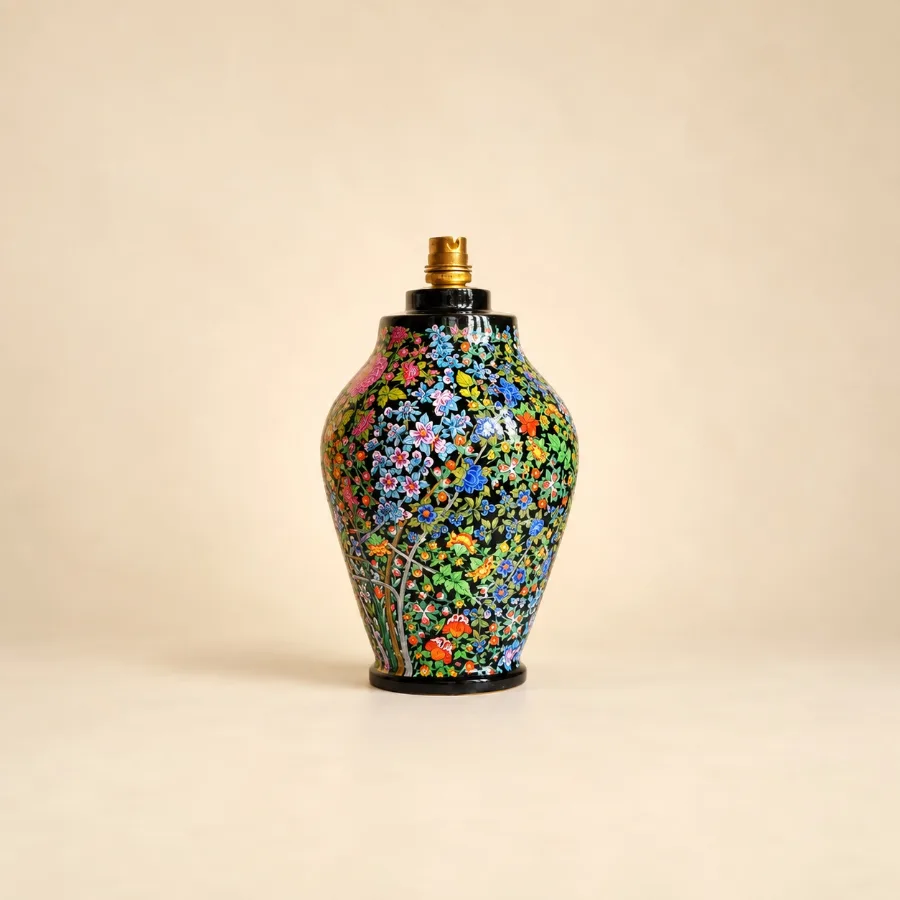
Many people come across a painted box from Kashmir, a gift, a family piece or a flea-market find, and wonder what it is worth. Nobody can give an exact price from a photo, but as makers we can tell you what separates an everyday souvenir from a fine piece. Here is what to look at.
1. Is it really paper mache?
Real Kashmiri paper mache is made from paper pulp shaped over a mould, so it is surprisingly light for its size. Many cheaper souvenirs are made of cardboard or wood and simply painted in a paper mache style. Look inside and at the edges: genuine pieces usually have a smooth, lacquered interior and a seamless body.
2. Is it hand-painted or printed?
Look closely, ideally with a magnifier. Hand-painting shows individual brush strokes, slightly raised paint and small irregularities from one flower to the next. Printed or transferred designs look flat and perfectly repeated.
3. How fine is the painting?
The more detailed the work, the more skill and time it took. Dense designs such as Fine Hazara, very fine outlines, careful shading and many colours all point to a higher-quality piece. You can learn the main designs in our guide to Kashmiri paper mache designs.
4. Is the gold real?
Some fine pieces are detailed with real gold. Real gold keeps a soft, warm shine and does not darken or turn greenish over time, while gold-coloured paint often dulls with age.
5. Age, signature and condition
Some older pieces carry an artist’s signature or workshop mark. Older work with very fine painting and good condition is the most sought after. Cracks, flaking lacquer, water damage or repainting all reduce value.
6. Size and form
Larger boxes, unusual shapes, sets and furniture take far more work than a small trinket box and are valued accordingly.
What do new pieces cost?
For comparison, our new hand-painted small boxes start at around $25, while larger and finer pieces, real gold work and furniture cost considerably more. See our jewelry boxes for current prices.
Want a second opinion?
Send us a few clear photos through the chat button on any page, showing the top, sides, inside and base. We are happy to tell you what we can about the design and the craftsmanship. We do not offer formal valuations, but we can usually tell you whether a piece is genuine hand-painted Kashmiri paper mache.