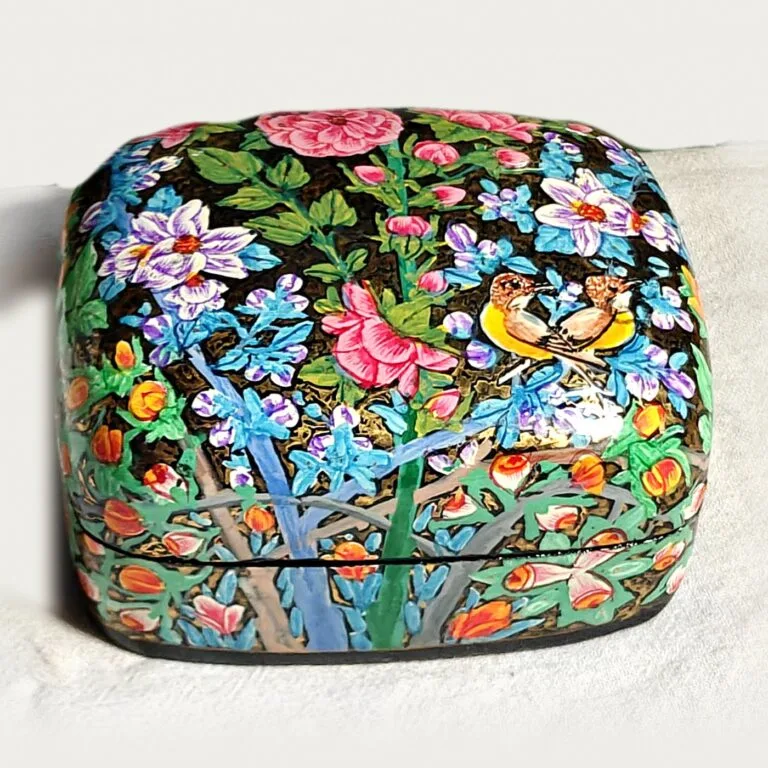
Every Kashmiri papier-mâché piece is painted in a traditional design, or art form, each with its own name and character. Knowing them makes it easier to choose a piece you will love, and to recognise fine work when you see it. These are the designs painted most often in our workshop in Srinagar, grouped by type, with a link to the pieces in each.
All-over floral designs
Hazara
Hazara means “a thousand”. Small flowers cover the entire surface so that almost none of the background shows. It is the design most people picture when they think of Kashmiri papier-mâché. Fine Hazara is the most detailed grade, with smaller, more closely packed flowers, thinner outlines and layered shading inside each petal, and it is used for statement pieces such as organisers, vases and room dividers. Generic Hazara uses larger, more spaced-out flowers and suits small gifts and decor at a lower price.
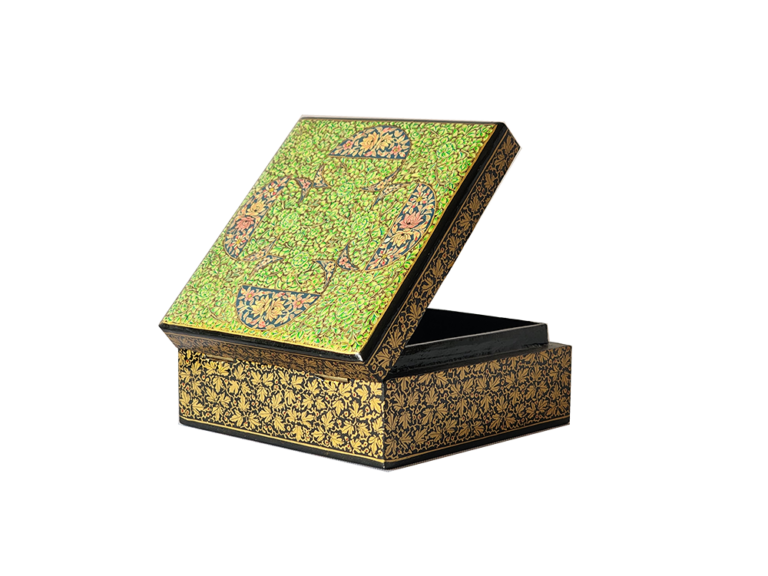
Gulandar Gul
Gulandar Gul means “flower within flower”. Smaller blooms and petals are painted inside larger ones, often around a central medallion, which gives the design depth and symmetry. Many Gulandar Gul pieces are also embossed.
Shabe Gul e Wilayat and Gule Wilayat
Shabe Gul e Wilayat spreads sprays of flowers and leaves across the surface, frequently highlighted with gold, and is a favourite for lamps and wall paintings. Gule Wilayat paints flowers and trailing vines over a rich solid ground, often deep red or maroon with golden detail.
Posh e Bagh
Posh e Bagh means “flowers of the garden” (posh is the Kashmiri word for flower). It gathers many kinds of garden blooms into one bright composition and appears on plates, bracelet boxes and bridesmaid gifts.
Birds and gardens
Gul-o-Bulbul
Gul-o-Bulbul, “the flower and the bulbul”, shows songbirds perched, feeding or in flight among peonies, roses and flowering branches, a theme loved in Persian and Kashmiri poetry. Each bird is painted individually, so no two boxes match. It is the main design of our small jewellery boxes, including the 24K gold-stroke Blue Garden and Emerald Garden series.
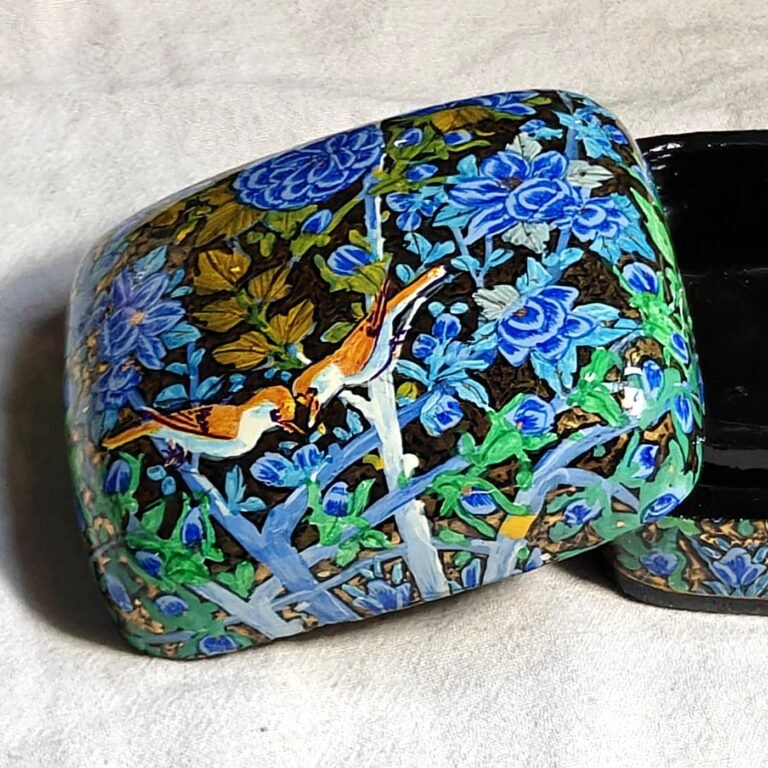
Shabe Gule Bagh
Shabe Gule Bagh brings a whole garden scene onto the lid: flowering branches, white and pink blossoms and birds such as kingfishers and finches over golden or green grounds. It is the design of our 7 × 4 inch boxes.
Bagh e Bulbul
Bagh e Bulbul, “the garden of the bulbul”, is gentler and more open, with birds set among foliage in soft colours. It suits plates and trays where the scene can be seen as a whole. For kingfishers, hoopoes and orioles, see the Birds of Paradise collection.
Symbols of Kashmir
Chinar
The Chinar design uses the leaf of the chinar, the great plane tree planted across the Mughal gardens of the valley and a symbol of Kashmir itself. It is usually painted in autumn reds, oranges and golds, either as a repeating pattern or one bold leaf, and makes a natural gift from Kashmir.
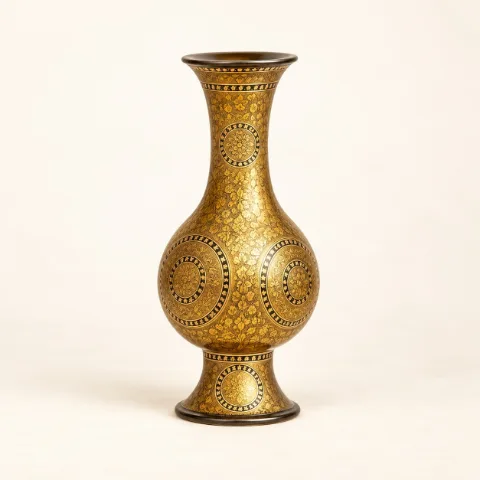
Paisley (Badam)
The paisley, called badam (almond) in Kashmir, is the teardrop motif made famous by Kashmiri shawls. On papier-mâché it is painted large and filled with tiny flowers, or repeated in rows. It is also the symbol in the Mughal Arts logo.
Pattern and ornament
Islimi
Islimi is the flowing arabesque: scrolling stems, tendrils and split leaves that interlace into one continuous pattern. It is admired for rhythm and balance rather than any single flower, and it needs a very steady hand, because each curve has to flow into the next.
Carpet design
Carpet designs borrow from Kashmir’s hand-knotted carpets: a central medallion, corner motifs and layered borders, painted in formal, symmetrical detail, like a miniature carpet on the lid of a box.
Cheen
Cheen is another traditional pattern from our workshop, seen on tall vases, bowls and jewellery boxes.
Figures and scenes
Mughal Darbar
Mughal Darbar pieces are painted in the manner of Mughal miniature painting: the royal court, emperors on horseback, elephant processions with howdahs and garden scenes. The figures are tiny and the detail is fine, so this is some of the most demanding work a naqash does. See our Mughal miniature boxes.
Techniques
Embossed art
Embossed work, known in our workshop as wutlayeth, is raised relief. Flowers, leaves and borders are built up before painting, so they stand out from the surface and catch the light under the lacquer. It takes longer than flat painting.
Real gold art
Real gold pieces are painted with real 24K gold, not gold-coloured paint, in fine strokes for outlines, leaves, backgrounds and highlights. Under lacquer, real gold has a soft, warm glow rather than a bright metallic glitter.
Christmas art
Our Christmas pieces bring the same brushwork to ornaments: trees, Santas, stars, hearts, moons, birds and cats. Browse them in hanging ornaments or read our Christmas ornament gift guide.
How to recognise fine work
- Density and size of detail. The smaller and more closely packed the flowers, the more hours went into the piece. Compare Fine Hazara with Generic Hazara to see the difference.
- Clean outlines. Fine outlines should be thin and even, with colours that meet crisply and do not bleed into each other.
- Variation. Repeated flowers and birds should be similar but never identical. Perfectly identical motifs usually mean printing.
- Continuity. The design should wrap around corners, sides and the lid edge without breaking.
- Finish. An even, glossy lacquer and a neatly finished interior show care at every stage.
To learn how a piece is made from start to finish, read how Kashmiri papier-mâché is made. Not sure which design suits you? Browse the full collection or ask us through the live chat on any page.