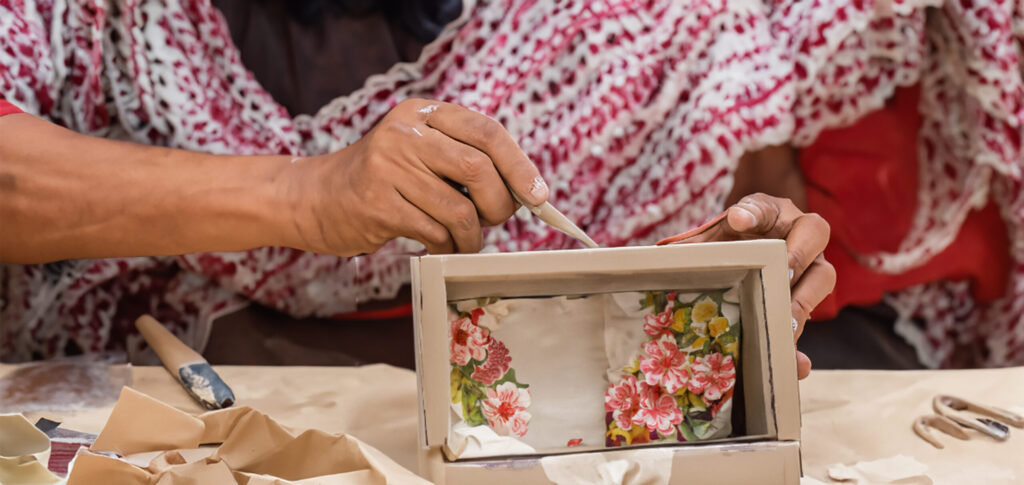
Every Kashmiri papier-mâché piece passes through two pairs of hands. The sakhtsaz turns paper into a light, strong form, and the naqash paints it, freehand, in one of the valley’s traditional designs. This guide walks through how that happens in our family workshop in Zadibal, Srinagar, what to look for in a well-made piece, and how to look after it.

What makes Kashmiri papier-mâché different
Papier-mâché is made in many countries, but Kashmiri work is recognisable at a glance: dense, jewel-coloured flowers, birds and leaves painted with very fine brushes, often highlighted with gold and sealed under a glossy lacquer. The form itself is only the canvas. What buyers are really paying for is the painting, and in Kashmir that painting follows named designs such as Hazara, Gul-o-Bulbul and Chinar that naqash families have practised for generations.
A short history
Kashmiri tradition links the craft to Persian artisans who came to the valley in the 14th and 15th centuries, and to Sultan Zain-ul-Abidin, who encouraged Persian arts in Kashmir. Early pieces were often pen cases, which is why the craft was long known as kar-i-qalamdani, “pen-case work”. Over the centuries the range grew to boxes, trays, vases, lamps and furniture, and from the 19th century Kashmiri papier-mâché was traded far beyond the valley. Today the craft is still centred on the old city of Srinagar, and Kashmir papier-mâché is protected in India by a Geographical Indication (GI) registration.
Stage one: sakhtsazi, making the form
Paper to pulp. Waste paper is soaked in water for days until it softens, then pounded into a smooth pulp and mixed with an adhesive so it holds together.
Moulding. The pulp, or layers of soaked paper, is pressed over a mould: a wooden or clay shape for a box, a vase, a bauble. The thickness has to be even, or the piece will warp as it dries.
Drying and releasing. The form dries slowly, then is cut free from the mould and the parts are joined back together. A box and its lid are shaped so they close neatly.
Smoothing. The surface is rubbed smooth, any gaps are filled, and a base coat is applied so the paint will sit evenly. A good sakhtsaz leaves a body that is light in the hand but surprisingly strong.

Stage two: naqashi, the painting
The naqash paints the design freehand, with no stencils or printing. A background colour goes on first. Then the main motifs are drawn and filled in, flower by flower and bird by bird, and finally the fine outlines and highlights are added with brushes of just a few hairs. On real gold pieces, 24K gold is applied in fine strokes for outlines, leaves or backgrounds.
The design decides how long the painting takes. A dense all-over Fine Hazara or a Mughal miniature scene takes far longer than a simple border. Embossed work adds another step before painting: the flowers are built up in relief so they stand out from the surface. Our guide to Kashmiri papier-mâché designs explains each one.

The finish: lacquer
When the paint is dry, the piece is sealed with coats of lacquer. This protects the painting from dust and handling and gives Kashmiri papier-mâché its deep shine. Many boxes are also lacquered inside, often in black or red.
How long does a piece take?
Several days for a small box, counting drying time between stages, and weeks for large pieces such as vases, lamps or room dividers. That is why made-to-order pieces take 20–45 working days before dispatch.
How to tell hand-made, hand-painted work
- Weight: real papier-mâché is noticeably light. A heavy box is usually wood or resin.
- Brushwork: look closely and you will see individual strokes, slight variations between repeated flowers and tiny overlaps of colour. Printed patterns are perfectly identical and flat.
- Edges and inside: the design should carry neatly around corners and lids, and a good piece is finished inside too.
- Gold: real gold has a soft, warm glow rather than a bright metallic glitter.
For more on judging quality and price, read how much a Kashmiri papier-mâché box is worth.
Caring for papier-mâché
Dust it with a soft, dry cloth. Keep it away from water, direct heat and long hours of strong sunlight, and don’t use chemical cleaners or polish. Vases are decorative, so use dried or artificial flowers rather than water. Looked after like this, a piece keeps its colour and shine for decades.
From our workshop to your home
Mughal Arts is the workshop of master craftsman Nasir Hussain Mugloo in Zadibal, Srinagar. Every piece we sell is shaped and painted by hand there. Meet our artisans, browse jewellery boxes, vases and Christmas ornaments, or ask us on live chat about a custom piece. Shipping is free on international orders over US$50 and on every order within India.