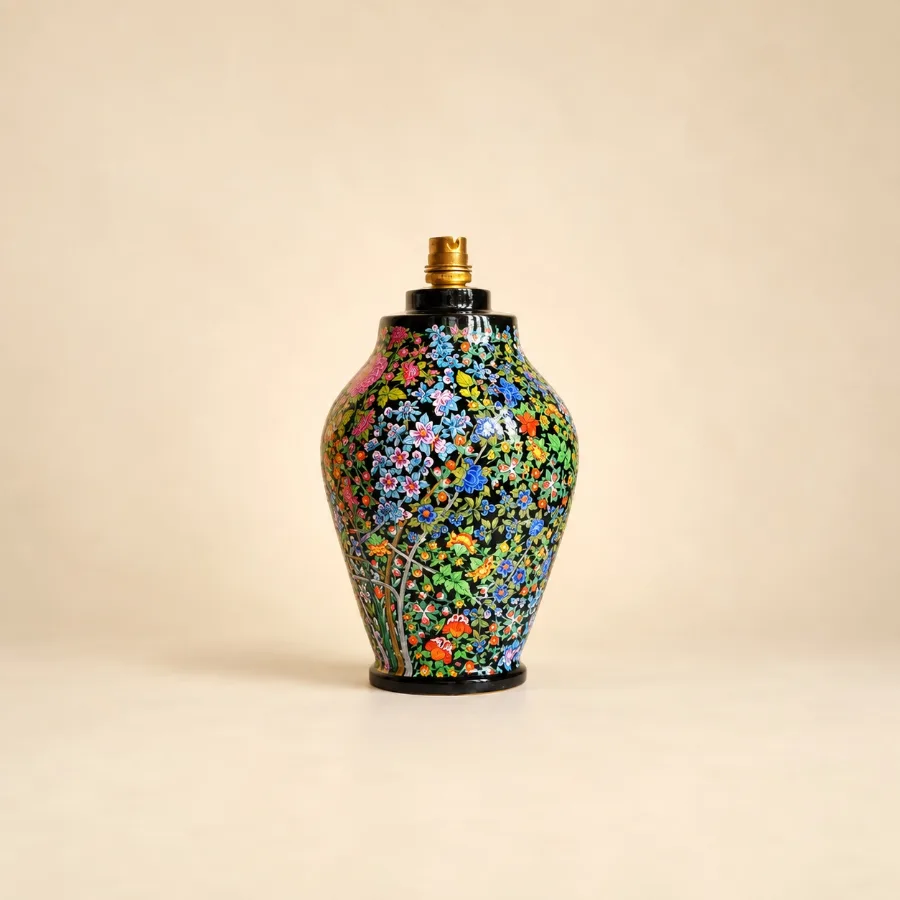
Most Kashmiri paper mache (papier-mâché) found in homes outside India is 20th-century work with modest resale value, but fine or early pieces can be worth real money. What decides it is the quality of the painting, the age, and the condition, in that order.
Many people own a box, vase or tray that was a gift, a family piece or a flea-market find, and wonder how old it is and what it is worth. Nobody can give an exact price from a photo, but as makers in Zadibal, Srinagar we can tell you what separates an everyday souvenir from a fine piece, and point you to the people who can put a figure on it.
Shopping for this Christmas? New hand-painted pieces ship free worldwide on orders over $50. Order by 27 November for Christmas delivery by India Post, or by 7 December with Shiprocket (US only).
1. Is it really Kashmiri paper mache?
Real Kashmiri paper mache is hand-painted and lacquered over a body of paper pulp shaped on a mould, so it is surprisingly light for its size. Many cheaper souvenirs are made of cardboard or wood and simply painted in a paper mache style. Look inside and at the edges: genuine pieces usually have a smooth, lacquered interior and a seamless body.
- Painted, not inlaid. Victorian English papier-mâché is usually black with mother-of-pearl inlay. Kashmiri pieces are covered edge to edge in painted pattern.
- Flowers, birds and chinar leaves. Look for dense florals (Hazara, “thousand flowers”), flower-within-flower patterns, chinar leaves, paisley, bulbuls and kingfishers, or Mughal court and hunting scenes. Our guide to Kashmiri paper mache designs shows the main ones.
- Gold line work. Fine gold outlines and borders are typical.
- A plain painted inside and base, often black, red or deep blue.
Russian lacquer boxes show fairy-tale scenes on black and are usually signed in Cyrillic. Persian pen cases are close cousins of Kashmiri ones, and even dealers sometimes label one as the other.
2. Is it hand-painted or printed?
Look closely, ideally with a magnifier. Hand-painting shows individual brush strokes, slightly raised paint and small irregularities from one flower to the next. Printed or transferred designs look flat and perfectly repeated.
3. How old is it?
No single sign dates a piece, but four checks together usually place it as 19th century, early-to-mid 20th century, or recent.
| What to check | Older pieces tend to show | Recent pieces tend to show |
|---|---|---|
| Body | Paper pulp throughout, thin walls, slightly uneven shape | Cardboard, wood or pressed board under the paint; very regular shape |
| Lacquer | Warm amber tone, fine crazing, soft worn edges | Clear, glossy, even varnish |
| Colours | Softer, muted colours; real gold that still shines | Bright colours; gold-coloured paint that has dulled or turned greenish |
| Wear | Rubbing on corners, base and lid rim where hands touch | Little wear, or wear that looks the same all over |
The form helps too. The craft was first known as kar-i-qalamdani, pen-case work. Pen cases, shawl boxes and turban boxes are the forms most often sold as 19th century. Coasters, napkin rings, Christmas ornaments and Easter eggs are 20th-century export forms.
Look under the base and inside the lid for a shop label, a stamp or a painted signature. Family history counts as well: a note of who bought it, where and when is worth keeping with the piece.
4. What makes a piece more valuable
Painting quality matters most: a finely painted 1970s box can be worth more than a crude one from 1900.
- Fineness of the brushwork. In fine work every petal is shaded, lines are hair-thin and steady, and the pattern stays crisp into the corners. Dense designs such as Fine Hazara point to a higher-quality piece.
- Density and difficulty of the design. Full-cover florals, court scenes with many figures, and raised embossed work take far longer than a few scattered flowers.
- Real gold. Some fine pieces are detailed with real gold. It keeps a soft, warm shine and does not darken or turn greenish, while gold-coloured paint often dulls with age.
- Age with evidence. A 19th-century piece is worth more when the age shows in the object itself or in papers that came with it.
- Size and form. Larger boxes, unusual shapes, sets and furniture take far more work than a small trinket box and are valued accordingly.
- Condition. Original paint and lacquer with honest wear is better than a piece that has been repainted.
- A signature or workshop mark. Signed pieces are uncommon, so a name helps.
5. What lowers the value
Damage to the painted surface costs the most, because the painting is where the value lies.
- Flaking or lifting lacquer, especially across the main design.
- Cracks, dents and crushed corners. Pulp does not spring back.
- Water damage: swelling, warping or a soft, spongy feel.
- Overpainting and home varnish. Fresh gloss over old paint is easy for a specialist to spot.
- A missing lid or liner, or one piece left from a pair.
- Coarse souvenir-grade painting: thick outlines, flat colour and the same motif repeated without shading.
6. How to find out what it would sell for
We do not quote prices for old pieces, because the honest answer depends on seeing the object. These are the reliable ways to get a figure.
- Search sold prices, not asking prices. On eBay, filter by “Sold items”. Auction-house websites list past results; search “Kashmir papier-mâché” or “Kashmiri lacquer” with the object type.
- Compare like with like. Match the form, size, quality of painting and condition. A dealer’s retail price is well above what a private seller receives.
- Ask an auction house. Many give a free estimate from photos. Choose one with an Indian and Islamic art or Asian art department.
- For insurance, pay for a written valuation from an accredited appraiser.
Send clear photos in daylight: every side, the base, the inside, any label or signature, and close-ups of the painting and of any damage. Include the measurements.
As a rough guide to expectations, small 20th-century boxes and coasters are common and sell for modest sums. Fine 19th-century pen cases, large pieces and signed work are the ones collectors compete for.
Caring for an old piece
Leave it as it is: cleaning and “restoring” at home is the commonest way value is lost.
- Dust with a soft dry cloth. No water, polish, oil or spray cleaner.
- Keep it out of direct sun and away from radiators, kitchens and bathrooms.
- Do not revarnish, touch up or glue it. If it needs repair, ask a conservator.
- Lift boxes by the body, not the lid, and store nothing heavy on top.
What do new pieces cost?
For comparison, our new hand-painted small boxes start at around $25, while larger and finer pieces, real gold work and furniture cost considerably more. See our jewelry boxes for current prices. They are made the same way as the old ones: the body is formed from paper pulp, then painted freehand and lacquered. You can read how Kashmiri paper mache is made step by step.
Order by 27 November for Christmas delivery by India Post (or by 7 December with Shiprocket (US only), 15 December with DHL Express). Our hand-painted Christmas ornaments, baubles and bells ship free worldwide on orders over $50. See the Christmas gift guide for ideas.
Questions people ask
Is Kashmiri paper mache valuable?
Some of it is. Fine painting, real gold, large size and proven 19th-century age raise value. Small, coarsely painted souvenir pieces are worth little beyond their charm.
Is it paper mache or wood?
Tap it and weigh it in your hand. Pulp is light and gives a dull sound. Many 20th-century “paper mache” boxes are painted wood or board, which collectors value less.
Should I restore it before selling?
No. Sell it as found and let the buyer decide. Amateur repair lowers the price.
Want a second opinion?
Send us a few clear photos through the chat button on any page, showing the top, sides, inside and base. We are happy to tell you what we can about the design and the craftsmanship. We do not offer formal valuations, but we can usually tell you whether a piece is genuine hand-painted Kashmiri paper mache.